On August 8 I was injured in a major bicycle accident which required surgery.
My wife and I go to the Edmonton Folk Festival every year. I have only missed 3 festivals since 1995. Since moving to our current home in the West End, we have usually ridden our bicycles. It is 12 km each way on quiet roads or paved trails. This means riding home in the dark or twilight.
We went as usual this year for the Thursday evening concert. We left a little late, wanting to avoid the line-up to get in. We don’t do the tarp run. With only two of us we can usually squeeze in between tarps. We arrived, got our weekend wristbands, bought a program and walked up the hill, finally finding a good place to place our tarp. We then went to the beer garden and had one beer each. It was a sunny humid day. “Are you going to have another beer,” my wife asked. “No”, I said “lets go have dinner.”. We both ate Ethiopian food sitting on the grass. The first act which we weren’t interested in was already playing on the stage. We then walked back to our tarp where we watched the second and third acts, both of whom were quite good. It was my plan to leave after the third act and miss the final act. The festival is 4 days and you have to pace yourself. Plus we could see the weather deteriorating to the west of us.
We walked back to the bike lock up to pick up our bikes. It had rained a lot over the previous days and there were swarms of mosquitos and I got quite a few bites before we left. We cycled thru Cloverdale and took the pedestrian overpass and then started cycling west along the trail. As we passed the Riverboat area, a wedding party was just dispersing. The first flashes of lightening were showing to the south and west. We kept on, my wife riding ahead as usual. To get home we had to cross the Saskatchewan river via the Low Level Bridge. This meant going on the underpass under the bridge in order to cross on the correct side of the bridge.
There is a small downhill going to the underpass. As I started to descend, I ducked my head as I always do going under bridges. I thought to myself, I don’t have to do this, there is lots of room. I could see my wife ahead almost at the other end of the underpass. There was a bright lightening flash. That is the last thing I remember.
I do remember going into a dream state. I first dreamed I was back at the bike lock-up, then that we were cycling on River Valley road (about 1 km away and where we were heading). Next I was awake on the ground talking to my wife. I was bleeding from my face. I remember saying I could ride home but my wife told me I had to go to the hospital which as I became more with it made more sense. My wife called a taxi and quite quickly one came. It was a minivan so we threw my bike in the back and I got in. My wife decided to cycle home and drive to the hospital. I was bleeding moderately heavily, she gave me the blanket we had sat on to put over my face.
I was starting to be more alert. I realized I had facial fractures. My teeth were pushed back in my mouth. I figured I might had a skull fracture and maybe even be bleeding intracranially. At points in the short taxi ride I felt drowsy but forced myself to stay awake. We shortly arrived the University Hospital ER. The fare was about $15, I gave the driver $20, given that I had probably bled over his cab. He really was a nice guy who was quite concerned about me. He brought my bike to security in front of the ER, who I remember were generally disinterested in looking after it.
I then went to triage. There was one person in front of me. When it was my turn, I explained what had happened. I was then sent to register and then directed to the waiting room. This was quite full and I had to squeeze into a chair between two people, holding the blanket over my bloody face.
In the 10 or so minutes in the waiting room I was able to reflect at what I had done to myself and what effect it might have on my life. I figured I had knocked out my front teeth. I most likely had facial fractures, possible some neurosurgical problems. I had been knocked out. I was going to need surgery I was not going to be able to work for an as yet unknown period of time. Given that I had a head injury would I even be able to go back to work. Would I be able to or want to ride a bike ever. Would I be able to play the saxophone? (I actually thought that).
I was eventually summoned into the back where I was taken into the trauma room with its resuscitation equipment, radiolucent bed and overhead X-ray (keep in mind I had been sent back to the waiting room by triage). I remember the nurse who walked me back as very kind and compassionate. Not at all like the ER nurses I used to work with, or read on Twitter. An IV was inserted, blood was drawn and X-rays were taken. A very nice ER doc came in trailed by a medical student. He went thru as thorough trauma assessment including rolling me over. They gave me ketorolac for pain and to my surprise it actually worked (they promised I could have something more potent if necessary). I shortly went over to CT to have facial and head CT. “Aren’t you going to look at my neck?”, I asked. The ER doc explained that I didn’t have any neck pain and had walked in. Makes sense. The techs in CT were also really nice and professional. After CT I was moved back to another area of the ER. Somewhere in that time my wife had arrived, having ridden home.
I lay in the cubicle for a couple of hours. I was fully awake and was aware that I was most likely out of major danger. My wife had brought my phone which she had taken from me at the accident scene. I had the prescience to email and cancel an appointment I had the next day. At some point we looked at my helmet. I’m not sure how it came with me. It was broken at the front, which made sense with the facial fractures. We tossed it in the garbage. I feel a little bad about this. It is an inanimate object but it did save my life and while I had only had it for a couple years, it had sat on my head for some pretty epic kilometres of biking.
My GP had signed me up for the patient portal so I could legally look at my blood work. I started getting emails in the ER telling me I had blood results, which I was able to log in and see.
Eventually the ER doc came and told me that I had no intracranial problems but had multiple facial fractures. He had phoned plastics who would see me the next morning. I could go home.
Oh and do you mind if the student sutures your only facial laceration.
I sutured lots of facial lacerations as a student so I said it was okay. He somewhat clumsily set up the suture tray, injected local and put in a few stitches. I noticed that rather than instrument tying he was hand tying each knot. We chatted while he was doing all this. He was from Victoria like me but we went to different high schools (a generation or so apart). The ER doc came back and asked if I wanted something for pain. I said I preferred Percocet over Tylenol 3 and I found a rare ER doc with a triplicate pad, so I got a prescription for 30 and 5 tablets to go. My wife got my car from parking and picked me up in front of the ER and she drove me home.
Because of the swelling I was told to sleep with my head elevated she set me up on the couch in my office with lots of sheets and towels to keep the blood off. I didn’t sleep. Too wired, too worried about the intracranial bleed I was sure I had. I keep on telling myself, you had CT of your brain, everything is okay. I had Percocet but was scared to take it. Eventually around 0600 I went back to my own bed and slept on a couple of pillows until about 0900 or so when my wife woke me because it was time to go back to the ER.
We checked into the ER again and told them that we were meeting plastics. We were directed back to the waiting room. This was quite full and the only seat was next to a disheveled “gentleman” stinking of cigarettes and possibly alcohol. At one point he bought a cellophane wrapped sandwich and tossed the wrapper on the floor. A burly man sitting kitty corner to us wearing a Boston Bruins ball cap yelled at him to pick it up and I thought I was going to have a ringside seat to an ER fight. Infrequently, people were summoned into the ER to be seen. To be honest most of them didn’t look very sick. It was sickest people who seemed to be ignored including the young lady moaning and holding her abdomen.
After about an hour a junior plastics resident came down to see me. He did a more thorough exam than the ER did. He looked somewhat unimpressed at my sutures from the last night. He said he would talk to his chief resident. Back to the waiting room where more or less the same crowd were still sitting there. A couple of hours later I met a more senior resident who told me that I would be admitted to hospital for surgery the next day but could go home over night on a pass. I was told to wait to see the chief resident, who came down later with the staff surgeon. I was quite relieved to see the staff surgeon. I had worked a lot with him when I worked at the centre of excellence. He explained that I had quite bad facial fractures and what he would do to me. He said that he could do my case in his elective time the following Wednesday but recommended that we try to get it done over the weekend on call.
Before I could go home however I had to be admitted to my bed so I could go out on pass so I had to wait another hour or so in the waiting room which was becoming old. First I was told that my bed was ready but they were waiting for a porter. I asked if I could just walk over there but was told it wasn’t allowed. Finally a porter arrived and we walked towards the ward. She got lost and I had to guide her to ward, where I was admitted and then sent home. My wife showed up with a milkshake and we drove home.
I was really tired by this time and I remember falling asleep sitting upright watching the football game on TV.
The next morning we got up bright and early and went to the ward where I was shown my “bed”. My “bed” was what they called an “overcapacity” bed which meant it was a stretcher in between two beds in room designed to have two beds. (Apparently they have not figured out how to put bunk beds in hospital rooms), Both my room mates were long term residents of the plastics ward. I was told that I was likely to be the second emergency case done at around 1000. Around 0900 a nurse came into start an IV for the OR. I have been out in the sun a lot this summer and my hands were little leather-like, as well while I had tried to drink lots, I was a little dry. She failed, as did the 2 nurses who tried after her. The third attempt struck a nerve and I got a shock down my arm. I got a little cross. I was sick of my little bed so I wandered out to the lounge in the atrium. Out there one of the plastics residents came but to tell me that I was further delayed but she at least bought a glass of ice water and a nurse bought a glass of juice. For the rest of the afternoon I alternately read, looked at my phone and occasionally wander around the atrium. At around 1600, I was getting a little tired so went back to my “bed” and actually was able to go to sleep. Someone tried to get me to eat supper but I told her I wasn’t supposed to eat. At 1800, a nurse came out and told me that my surgery was cancelled that day. I was a little relieved. Based on my experience I was looking at a 6 hour surgery and I wasn’t enthusiastic about coming back after midnight after facial surgery. My wife came and picked me up and we went to Booster Juice and then home. On the way home, the ward phoned me and told me that they thought I could get done first if I came in a 0615 Sunday am.
We showed up at 0615 the next day and I went back to my “bed”. It quickly became apparent that I wasn’t going to be first on the list. Around 1100 a plastics resident told me that I might get done later in the day. I told him I preferred to wait at home and could get back to the hospital in 15 minutes if necessary so I went back home. Later in the afternoon I was advised that because of 5 transplants being booked they wouldn’t be doing me on Sunday and could I come back Monday am.
No doubt the Centre of Excellence was busy Saturday and Sunday but I have worked enough weekends to know how the emergency slate is gamed and nobody wants to follow a 6 hour plastics case. To his credit and my detriment, my surgeon wasn’t very good at this gaming. It is difficult to argue about transplants, although they never seem to be an emergency between 0800 and 1700 Monday thru Friday.
I was figuring this all out. Monday am I phoned the ward and told them that I was staying home and they could call me when my case was booked. Later Monday I got a phone call telling me that there was no chance I would get surgery on Monday but I was now booked in elective time Tuesday afternoon. This was a bit of a relief. I now knew more or less when I was going to have surgery. I had gotten use to the way my face was, I wasn’t having much pain, I had Percocet and was enjoying my diet of milkshakes, smoothies and beer.
I went back to the plastics ward Tuesday. Maybe they felt sorry for me, but I now had a private room with a window. A nurse came in and put an IV in my antecubital fossa. I waited reading a book I had started and checking my emails and Twitter. Some time after noon, two porters showed up with a stretcher and I was off to the OR.
Aside from colonoscopies I have never had a general anaesthetic. Aside from having had 5 days to think about this, I had some reasons to be anxious. It had been 13 years since I worked at the CofE and the anaesthetic department had turned over quite a bit. I knew as a facial smash I might be a difficult intubation. And then there was the impending 6 hour surgery. I told myself that from my point of view I would be asleep the whole time but I was still nervous. I worried about coughing on the tube, nausea and pain. As we got into the OR I looked for nurses I knew from before. I was wheeled into their receiving area where a nurse interviewed and checked my chart. A nurse who used to work at my hospital came in and talked to me which I appreciated greatly. (I occasionally see someone I know waiting for surgery and go over to talk to them; I never realized how appreciated it is).
After a while, first the surgeon and then the anaesthesiologist came to talk to me. I had never met the anaesthesiologist although she told me she had trained in our program. She told me that I would be intubated nasally. I had figured that with maxillary fractures, I would be getting intubated orally but I guess they have to be able to look at the alignment. The surgeon had told me that I probably wouldn’t but might be wired shut at the end. I wondered how I would respond to waking up like that.
I was pushed into the room. I could see the scrub nurses setting up. My CT scan was on the viewbox but without my glasses I couldn’t make out details (not that I could with glasses). Lying supine, I saw my anaesthesiologist pushing the Glidescope into the room. That should have made me feel anxious but at that point I wasn’t caring much and I figured she was just being safe. I had told her not to modify her usual technique for me. She told me she was injecting midazolam. I had had midazolam before for colonoscopy and know what a potent amnestic it is. I knew I had a few seconds of consciousness left. I remember about 20 seconds.
Seeming seconds later, I was in the recovery room. I was extubated. I couldn’t believe how awake I was. I had a little pain but no nausea. I looked at the clock and it was just after 1900. That took a while, I said. The nurse asked if I wanted something for pain and I said yes. She gave my 0.6 mg of hydromorphone and told me I had gotten 2 mg in the OR. What seemed shortly after I was told that I was going back to ward. When I looked at the clock however it was after 2000. Being pushed back to the ward, I saw my wife waiting for me in the hall. I was so happy to see her.
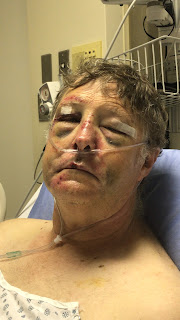 |
| I looked a little like Ali after the Joe Frazier fight |
I was finished surgery but was not out of the woods yet. There had apparently been problems with my nasal intubation and both nostrils were clogged with clot. Not withstanding my nose bleed they still gave my low molecular weight heparin (but said I couldn’t have NSAIDS). The intermittent compression machine they put on my legs kept me awake as well. I really didn’t feel that tired however after my general anaesthetic. The IV infusion pump periodically alarmed as well.
Morning came and the plastics housestaff came in, the 3 residents I had already met plus 2 medical students. One of the residents told me I had been a difficult intubation. Apparently because of my size, (6’5”) a regular ETT barely gets from my nose to the vocal cords. This presumably explained the nosebleed. They said I could go home after a CT of my facial bones and that the IV could come out. The anaesthesiologist had put another IV in my saphenous vein (I do that too sometimes) which was affecting my mobility. I decided to disconnect the IV. There was an extension with a needleless connector so I just unscrewed it. The pump was still running. I know how to shut off an IVAC pump but I figured it might wreck the charting so I called the nurse. A nurse came fairly promptly and I got a lecture about not playing with the IV. The same nurse came back about 10 minutes and apologized, saying she didn’t know I was an anaesthesiologist.
A breakfast tray arrived with a muffin and a box of bran flakes. It had now been about 5 days since I had eaten anything solid. “They expect me to eat this?”, I thought. I soaked the bran flakes in milk and gingerly ate them and the muffin which I broke into small pieces. I really didn’t feel like eating but I knew if was part of my recovery.
Later in the morning I went over to CT by wheelchair. The CT techs were so pleasant and that scan took about a minute. A CT scan when I was a resident took about 30 minutes. Then back to the ward. A friend who still worked at the CofE came over to visit, we chatted along with my wife who had arrived from home. I was told that my CT scan was read and was okay but the surgeon wanted to see me. I was getting a little tired of my room so we walked out to the atrium where we bumped into him and he gave me some final instructions. “You really are in hurry to get out of here”, he said. “Sorry,” I said, “I hate this place.” A little ungrateful perhaps because overall they had been so good to me. I think what I meant was I want to get home and start getting better.
We drove back about 15 minutes to my house. I was still suffering the effects of the concussion and the general anaesthetic. Everything was moving so quickly, I didn’t think I would have been able to react to it all.
The next few days seem a blur. I am not the busiest person but now I was in enforced inactivity, my only job was to get better. I spent most of the next 4 or so days reading, looking at my I Pad and having random naps. A few times I went out in the car with my wife. Things were still moving to fast for me. The first two nights I really didn’t sleep. This was probably the effect of the anaesthetic and possibly also due to the dexamethasone I had been given. The second night home, I became obsessed about a peri-operative MI. I remember thinking, “I am going to die tonight.” I had Zopilcone but was scared to use it, my face was still swollen, my nose was plugged and I was worried about obstructing. Later I started using the zopiclone which gave me a deep sleep for 3 hours after which I slept fitfully often until 0800 or 0900.
Eating was still painful and I didn’t have much of an appetite. My wife cooked some delicious meals for me that I could eat on my soft diet. I regret I didn’t appreciate them more because they were really good. The surgeon had left wires in my mouth in case he had to wire my jaw (he didn’t have to) and one of them was irritating my gum.
On Thursday after surgery my brother phoned me. My 90 year old mother had been taken to the hospital with abdominal pain. I talked to the ER doc in Victoria and it appeared that she had perforated her colon. I knew that this would be fatal and I told him to just keep her comfortable. I wondered about flying to Victoria to “say goodbye” but I knew I was in no shape to travel. Maybe if my surgery had been done on the Saturday like it was supposed to have been done. My mother died on Sunday. The team in Victoria did as good a job as they could trying to keep her comfortable but with the peritonitis she must have had along with her dementia, it must have been a horrible 3 days for her before she finally died.
I did visit my mother in late July and was able to spend a few hours with her. I tried to comfort myself that I had said my goodbyes but I still regret not being able to see her one more time.
On Saturday my wife suggested that we go and visit where I had crashed 9 days earlier. We went to the farmers market first. I still had a lot of facial bruising. As it happened we ran into someone I knew so had to explain what had happened. We then drove to the other side of the Low Level Bridge, parked and walked across. I wondered if I would get anxious returning to the site but I felt okay. Almost immediately looking at where I had gone down, I could see why. The pavement was rutted and broken off at the right side of the trail. I must have hit the edge of the trail where it was broken and slammed down hard. I felt a little better. I don’t remember the impact but had always worried that I had done something stupid and that was why I crashed. Now I felt a little angry that the city could leave a busy paved trail in that condition.
 |
| The scene of the crime. |
By Monday one of the wires which was digging into my gum was really starting to bug me. My surgeon had told me that he would be on vacation but that I could contact the on call plastics thru the hospital switchboard. I figured however that would just result in being told to go to the ER and wait and frankly I had spent enough time in the ER. I thought about asking one of the plastic surgeons at my hospital to look at it. Wednesday morning I woke around 0600 and had a revelation. The plastics house staff round at 0600, I could phone the ward and ask to speak to them or leave a message. I did that but the nurse I talked to was very protective of the doctors although I did get him to take a message. He did have a good suggestion, dental wax. I googled dental wax and sure enough London Drugs carried it. I finally felt good enough to to drive and headed over there just after opening and picked up some dental wax. Later in the morning one of the plastics residents called me and said my surgeon, who it turned out wasn’t yet on vacation , could take out the wires in the surgery clinics. I did this later in the afternoon. At the clinics I met a nurse who had worked in the Pain Clinic years ago when I was at the CofE and we got to chat a bit and I got the wires removed except for the ones holding my upper incisors in.
It was Tuesday that I finally woke feeling almost normal. It was a beautiful late summer day and I knew I wanted to go for a walk. That morning I walked with my wife and the dogs down into the river valley to the zoo. Walking along the dirt path beside the river was such a healing experience. We had coffee at the coffee shop outside the zoo before walking home. This involved a climb out of the river valley and I was relieved that my conditioning hadn’t suffered much. We did this walk every day for a few days. I started looking at the step counter on my phone and tried to make the 10,000 step maker every day.
My work in chronic pain had made me aware of the risk of PTSD after an accident I had so almost as soon as I got home from hospital I called the medical association’s Physician and Family Support line and got an appointment with a psychologist. Because it was the summer I wan’t able to get in right away but did get an appointment for Thursday. I drove down to the office just off Whyte Avenue. I was feeling really good. I was out of the woods, I was going for walks every day and was driving again. The psychologist and I sort of talked for about 30 minutes when it was clear that I was doing pretty good. I sort of apologized for wasting his time. Apparently getting knocked out so you don’t remember anything is a good thing. On the way home, I stopped and bought a new bike helmet.
I went to the Eskimos football game the following day Friday. It was not a very good game and my wife and I left in the 4th quarter. It was dark when we left. I park at a nearby hospital where I have reciprocal parking privileges. Driving home in the dark with the traffic and the bright lights brought back memories of my taxi ride to the hospital just over 2 weeks earlier. A cyclist wearing dark clothes and no helmet crossed the road in front of us and this upset me for some reason. Maybe I wasn’t as good as I had made myself out to be.
It was around then that my wife noticed some redness in the skin around my nose. It looked a bit like a skin infection. I figured there was a plate underneath. I have of course seem some horrendous post-surgical infections and had views of my face sloughing off. By then we had gone down to the dacha in Canmore to see if some mountain air would pick me up. Fortunately there was a walk in clinic open on the Sunday so I went there shortly after opening time and saw a doctor who it turned out was a former next door neighbour. I was started back on antibiotics. (When I saw my plastic surgeon later, he didn’t think I had an infection but told me to finish the prescription).
Gradually recovering, the question was when exactly could I go back to work. I had been told it would take 3 weeks to recover. After two weeks I felt a lot better but I still had some facial swelling. As it had turned out, I injured myself with 2 weeks of vacation left. Worst vacation ever. (We had planned to take in the Salmon Arm Roots and Blues festival the following weekend but obviously didn’t go.)
I was supposed to work the week before Labour Day and be on call 3 times over the Labour Day weekend. That obviously wasn’t going to happen. My colleagues really pitched in and all my work slots were filled within a few hours of me posting that I wouldn’t be able to work. It turned that because of a family problem with another anaesthesiologist we were short staffed the week before Labour Day. I actually volunteered to work. My offer was prudently ignored.
Eventually I decided that I would do my scheduled work the Tuesday after Labour Day. I am self employed, as they say, I have to eat what I kill. I have significant savings so I could probably have stayed out longer. It was more that I felt I was ready and was worried about losing my skills if I stayed out longer. I was already taking most of October off, if I missed September that would be a long time off. That was in addition to all the time I had taken off in the summer.
I had suffered a big knock to the head and I was worried about cognitive effects. I keep on going over drug doses in my head and imagining scenario and what to do. I felt I was ready cognitively.
My first day back was a single all day flap. That was great for me, just 1 IV to start, 1 airway and then a lot of sitting. I got thru that. The next day was a urology list with about 8 cases and I sailed through that. I was back.
I have more or less recovered now. I still have some facial numbness and I will need dental work on my front incisors, hopefully only being capped. My teeth are a little mis-aligned and chewing is still difficult. A pleasant side effect of not enjoying food as much was a 15 lb weight loss. After the surgery my face was numb and dysesthetic, so I didn’t want to shave. I now have a beard and my wife even likes it.
I still think how fortunate I was. If I had not been wearing a helmet I may likely have died. The transplant unit was across from the plastics unit and I think how bits of me could have been living across the hall in other patients. I was glad I was riding with my wife; quite often I have ridden home from the Folk Festival alone. I am glad I didn’t have to rely on the kindness of strangers.
And what about the Canadian Healthcare system? Sure I had to bunk with 2 other people in a room designed for 2 and I waited 5 days for surgery. But I got seen in the ER right away, I had 2 CT scans and I major surgery and the only things I paid for was $20 for the taxi and a few dollars here and there for OTC meds. What a great system and yet politicians and sadly quite a few doctors want to blow it up. Shame on all of you.
And I remember how nice everybody was to me, the emergency nurse, the emergency physician, the CT scan staff, plastic surgeons, the floor nurses and of course the anaesthesiologist and the OR staff. Sometimes in my career when I was tired, busy or frustrated I haven’t been the nicest to patients and I regret that now.
I really have to thank my surgeons. I like to make fun of surgeons but the care I got from the whole team was fantastic.
I have to thank my anaesthetic colleagues who are the greatest colleagues anybody could ask for. I had to miss work during the summer and was on call on a long weekend. In Edmonton we have a very short but nice (not this year so much) summer and people gave up days off in the summer for me. And they picked up every day within hours of it being posted.
And of course my wife. She was so calm in the face of what was a really serious injury. She let me recover slowly with no demands. There were times when I just wanted to be left alone and she did that too. And of course the great food, from the smoothies before surgery to the delicious soft diet food after.


 Posts
Posts

